The AI Shopper Is Already Here. And She Looks Like You.
by Yasmin J.-Mar 3, 2026-6 min read
Fashion has a long history of predicting the future in the wrong direction. For years, the industry promised that algorithms would fix shopping. That personalization was coming. That technology would finally make it easier to find what you needed, in the right size, at the right time, without the hours of effort that online retail usually demands.
The predictions were right. The timeline was just slower than anyone wanted to admit.
Because now, quietly and quickly, something has shifted. The AI shopper is here. And according to research from The Business of Fashion and McKinsey, she is already a significant and growing part of how professional women find and buy clothes.
What the Data Actually Shows
The State of Fashion 2026 report dedicates an entire theme, titled The AI Shopper, to this emerging reality. The finding is striking: 53% of US consumers who used AI for search in Q2 of 2025 also used it to help them shop. That is not a niche behavior. That is mainstream adoption happening faster than the fashion industry was ready for.
More importantly, consumers are not just using AI to search for products. Some are already using AI as style and wardrobe consultants, seeking advice on what to buy, where to buy it, and how to put it together. The report notes that fashion brands' presence in AI chatbot responses is becoming the new SEO, and these dynamics will only grow more pronounced as agentic commerce accelerates in the second half of the decade.
For context, agentic AI refers to systems that do not just respond to questions but take action on your behalf. Looking up options, comparing them, making recommendations based on your history and preferences, and in some cases, completing purchases directly. This is not science fiction. It is the direction the entire industry is moving, and the women who benefit most will be the ones whose shopping systems are built for it.
Fashion brands' presence in AI chatbot responses is quickly becoming the new SEO.
Why Professional Women Are Leading This Shift
It makes intuitive sense that high-performing professional women are among the earliest and most committed adopters of AI-assisted shopping. Consider what the alternative looks like: multiple browser tabs across competing retailer sites, inconsistent sizing information that makes ordering feel like a gamble, return processes that turn into a second job, and the mental overhead of trying to pull coherent outfits together across brands that were not designed to speak to each other.
This is a significant drag on the attention and energy of women whose time is genuinely their most valuable resource. A senior leader preparing for a board presentation does not have two hours to spend navigating fashion discovery. A founder building a company while managing an unpredictable schedule does not have the cognitive bandwidth for a shopping experience that was designed for someone with a leisurely afternoon and infinite patience.
The 2025 State of Fashion report captured this precisely, noting that shoppers once dazzled by endless online selection now struggle to find what they actually want. Fifty percent of fashion executives in that same report identified consumer product discovery as the most important use case for generative AI in fashion. The problem is understood. The question is which tools will actually solve it.
From Discovery to Delegation
There is a meaningful distinction between AI that helps you find things and AI that helps you decide. The first reduces friction in a process you still have to manage yourself. The second removes the process from your plate almost entirely.
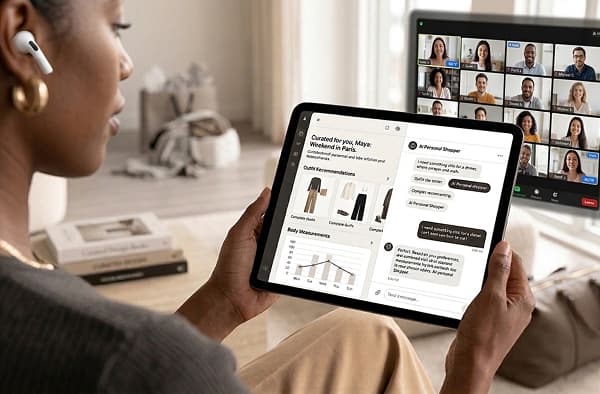
Style Magnet was built around the second model. Through our prompt-based request system, you can describe what you need and the moment you are dressing for, and using your specific body shape and measurements from your profile, the system returns curated outfit combinations that fit your life. As the platform learns more about your preferences and receives your feedback, its recommendations become more precise over time.
For women who choose to go further, Style Magnet's AI personal shopper can handle the entire purchase process: searching for the best available price across designated retailers, sourcing approved substitutions when items are unavailable, completing the purchase on your behalf, and coordinating returns with pickup from your preferred location when needed.
This is what intelligent delegation looks like in practice. Not another app to manage, but a system that manages on your behalf.
The Bigger Picture
The State of Fashion 2026 report describes AI not as a competitive edge for fashion companies, but as a business necessity. Companies that fail to integrate AI into how they serve customers will find themselves falling behind the expectations that early adopters are already setting.
But this transformation is not only about what brands do. It is about what you, as a consumer, can expect and demand. The shopping experience that was designed for someone with unlimited time and patience is already being replaced. The question is not whether AI will reshape fashion discovery. It already is.
The question is whether the tools doing the reshaping were built for women like you, with your time constraints, your career, your body, and your standards.
Style Magnet was built for exactly that woman. And she is already here.